Saturday, March 20, 2010

Albania

I was just flipping through my listed favorites over at YouTube and came across this oldie-but-goodie from the Cheers era. I like the kind of smile it gives me.

No surprise, probably, that Coach was my favorite cast member.


Over at Ken Levine's blog, we find this information about the episode from script writer Tom Reeder:

Hi, Ken --

As it turns out, I was the writer of that script. It was called "Teacher's Pet", and the storyline had to do with Sam going to night school to get the high school diploma he'd never achieved. Inspired by Sam, Coach also went back to finish up -- he was a couple of years short. Coach proved to be a more diligent student than Sam, because he developed his own unique mnemonic devices. One of them was a song (to the tune of "When The Saints Go Marching In") that contained facts about Albania for an upcoming Geography test: "You border on the Adriatic"... "your land is mostly mountainous"... "and your chief export is chrome".

In fairness, I think Sam Simon may have supplied some of the words for the song, and I may not have the lyrics exactly right, but I'm pretty certain "your chief export is chrome" was the last line. Nick Colasanto really sold it. It was pretty funny.

Friday, March 19, 2010

Update on Missing Child: Lindsey Baum


As is usual, I come away confused by the latest articles, posts, and messages about Lindsey Baum, the 11 year old girl missing from McCleary, Washington, since June 26, 2009 -- abducted, it appears, on her short walk home in what was then a peaceful, naive, and quiet town.

In what I *think* is a typographical error, one news source announced that the reward grew to $120,000. The last I heard, just a few weeks ago, it was $20,000.

Now... $120,000 sounds grand, and let's just run with it! [I haven't yet blogged about my opinion of someone driven by monetary gain in this matter, have I?]

Lindsey J. Baum's case was featured on Nightline Tuesday night. The emphasis was on the techniques employed by the FBI's Child Abduction Rapid Deployment (CARD) team -- from interviewing residents and developing profiles to investigating the whereabouts and activities of area sex offenders. The associated ABC News article can be found here.

I recently declared that I would not contribute to the burgeoning use of expressions employing the word "disconnect" as a noun.

There is a real disconnect between what the ABC News show and articles put forward, in terms of the FBI's activity in McCleary, Washington, and the information more locally sourced.

Even so, I will dutifully report that in the wake of this coverage, 12 people have become persons of interest in the case, 2 of whom are apparently of considerable interest.

The best summation of what appears to be a stalled investigation, despite the FBI's special team antics?

"Somebody saw something and somebody suspects something," said Melissa Baum [Lindsey's mother]. "Somebody knows something and they're not coming forward. I think that's my greatest frustration through this all is, I know there's somebody out there and for whatever reason, they're not sharing whatever information that they have."

Once upon a time, not so long ago, I would never have believed that someone could withhold information about a missing child. Of course, I never thought anyone would reach my blog by typing this into their search engine, either:


I know what happened to Lindsey Baum...


Earlier posts about Lindsey on this blog can be found here.

Wednesday, March 17, 2010

It's Bob: The Rules of the Road

REPOST from March 26, 2009 This recounts the "Bill"-episode to which my friend Kathleen refers in the next post.


On a recent road trip, Fred took the wheel and appointed La Belle Bianca Castafiore, swathed in a pink feather boa and topped with a demure chiffon petal hat with netting (in ivory), to ride Shotgun.

It would be tacky of me to point out that she wore a *stunning* brick red sheath dress.

According to About.com, that well-known authority on haute couture, the sheath dress "features a figure-hugging silhouette with a defined waist (no belt or waistband). This short (mid-calf or shorter) dress works well in sleeveless styles on well-toned bodies."

I will give you a moment.

As you can imagine, I was fairly put out -- offended in both my fashion sense and my profound sense of decorum -- because I am of the Old School. To ride Shotgun, a person must call Shotgun and wear only fine natural fibers, textiles that obey the dictates of a discrete palette. It is a privilege to be earned, that one merits, not a given right to exercise -- sort of like healthcare. But I won't quibble over words of hierarchy, over Terms of Snoot; I will simply posit the well established Official Shotgun Rules, according to which:

* Shotgun must be called, and the calling witnessed.
* Shotgun may only be called within the timeframe established within the traditions of one's merry company. In our case, this would be within 5 minutes of departure, and when every potential rider and driver is in the presence of the dragster, the very lovely Ruby, Honda CR-V.
* You must have shoes on. No one cares if you sport shoes in the car or upon arrival, but you must be shod, chaussé, in order to call Shotgun.
* If Shotgun is not called by the time a hand grips the shotgun door handle, appointment shall be made by the driver. (Here at Marlinspike Hall, Tête de Hergé, we deviate from the International Rules, whereby: Shotgun can no longer be called once someone's hand is holding the shotgun door handle. This officially stakes their claim to Shotgun and calling it at this time is just redundant. This is one scenario where a person does not actually have to say Shotgun to get the seat. This rule's importance is that no one has to be around for you to stake your claim to Shotgun, whereas usually one other would-be occupant must be present for you to call it.)
* Rock, Paper, Scissors resolves all disputes -- from map-reading and how best to evade rush hour traffic to who shall pay for gas and, more important than fuel, sundries. (Why more blogosphere time is not devoted to the discussion of sundries -- from bar snacks to oddments -- I don't know, for ours is a sundry-driven culture.)
* And the rules go on and on, open to careful revision due to the plastic, evolving nature of Shotgun. You get the idea. This is not a wild, ungoverned affair -- we are civilized, we do things a certain way. Tradition *matters*.

Back to my anecdote. Here is the rule that, when broken, finally chapped my delicate hide that day: If someone is driving an automobile other than its owner and the owner becomes a passenger, then the owner automatically gets Shotgun. When applied, this rule shows respect to the owner of the car.

Ruby, the Honda CR-V, is mine. She is equipped with Bruno, the wheelchair lift. Bruno is also mine. My point? I am the owner; I rule. I get Shotgun, de jure, de facto.

That La Belle Bianca Castafiore decided to sing out and "call" Shotgun for the first time in her morbidly obese life was just... quaint; That Fred delighted in this aberration? Well, *that* was... dégoûtant!

And so it was that we set out, framed in a modern Decameron, novellas waiting to spring from our lips -- we, the happy travelers, escaping the smog, oppression, and pestilence of our city.

Castafiore up front, me in the back. Fred, all pleased with himself, at the wheel. Truly the makings of a literary event, a salon on wheels.

First, we told tales of hitchhikers and of hitchhiking. I am not a good story or joke teller -- in fact, people around me are prone to disappear, if disappearance is at all possible, when it is my turn to jest or narrate. But in this instance, I had a captive audience.

Still, it was difficult to think of tales that were not already known to Fred. This had me delving, unfortunately, into my supply of Squirrelly Stories. The Good Fredster and I have been together for 18 years -- certainly a relationship that I treasure, and his opinion one that matters much. I was not, however, feeling particularly, um, close to him at that moment, and so it was that I risked his disdain and introduced my audience to Bob.

I dropped out of college at the end of my freshman year. There is no fascinating subtext. It was a perfectly ordinary case of rebellion and confusion. So I moved to a neat-o city, took a short nurse's assistant training, and got a job at a large charity hospital, where I worked in the Post-Intensive Neuro Unit. I am sure these units are now called something that sounds much more chic.

Having been in a whirlwind romantic relationship the previous year, part of the reason for my disaffection with academics, I wanted only to make enough money to keep body and soul together, audit some courses at the nearby university after work, and maybe meet some interesting folk who could show me more of life. To say that I was lacking in savoir faire was an understatement.

Enter Bob.

We met at work. Bob was an LPN -- his job was to dole out the meds. He was 15 years my senior, kind of scruffy, spoke with the distinct regional twang, and seemed truly compassionate to the odd mix of patients we had. On one end of the floor, there were mostly post-op back patients, laminectomies, fusions, diskectomies, and the like, with an occasional brain tumor thrown in for good measure. On the other end? Gorks.

I was there for about two years before I resumed my academic career, finally majoring in what made the most sense: Romance Languages and Literature, with a minor in Anthropology.

Toward the end of my stay, Bob asked me out. I was once again in another relationship at the time, but it was one with no future -- a much older married man who owned a health food store, sold drugs, and raised pythons on the side. Phil's marriage was "open," and I was actually on good terms with his wife, getting to know her rather well over coffee in the mornings. (She was sleeping with my roommate. Indeed, our kitchen was an interesting place to start the day, for in addition to her fondness for Phil's wife, my roomie Debra had an affinity for musicians of all genders and orientations, and she regularly brought them home. It was a toe-tappin' place.)

I had the Castafiore woman and Fred wrapped around my little finger at this point. Fred seemed to be overheating, in fact. His gaping mouth was quite like that of a fish out of water. His face clearly read: Where has my demure and straightlaced Retired Educator gone? How can the trollop of this tale be the same person as my Beloved Smarty-Pants?

Hmm. Earlier I said there was no subtext. There is always a subtext, Dear Reader! Usually, several. But it kills a story to spell them out, much as starting with the punchline kills most of my jokes. I so wanted to tell Fred how great it had been to learn, as part of the lesson of those years, that I was a good and decent person.

Anyway, Bob and I had dinner, then went for a drive in the country.

He cranked up the radio, reached over and took a big plastic bag from the glove compartment of his truck, plopped it down between us, and said, "You first!"

In that bag was a rainbow of pills, tablets, and capsules. Probably over a thousand of them.

Smirking at my sudden paralysis, Bob reached in, scooped half-a-handful, popped them in his mouth, and swallowed them down with his beer. I was cold, and shivering, so scared. By then we had driven well into the mountains, and nature, too, was cold.

Something told me to make myself small. I retreated into my seat and said not a word as Bob returned to the bag of goodies several more times and started on another beer. I had not a clue where we were.

About an hour into the drive, Bob began muttering strange things and shooting scary looks at me. I had assumed monstrous proportions in his mind; I had become some sort of threat.

He did the only logical and gentlemanly thing -- he suddenly pulled the truck over and pushed me out, then drove away at high speed.

For the first time in my 20 years, late, late on a cold night, alone out in the boondocks, I flexed my thumb.

Three cars sped by with no intention of stopping to pick me up. In my heart, I was relieved, for I knew they were all ax murderers.

By the time the burly, hirsute dude in the 18-wheeler Mack truck gently pulled over onto the gravel, I was in tears and hugging myself out in the icy air, feeling strangely insubstantial.

He had a thermos of black coffee, and the heater in the cab was humming. We didn't talk much. I told him where I lived, not thinking that a real hitchhiker would hardly expect to be taken straight to one's front door -- not thinking, also, that Debra might not appreciate me showing an unknown trucker where we lived.

He probably risked some hefty traffic fines by taking that truck onto residential streets, but he did indeed deposit me at my front door -- with not a threatening word or glance, not a moment of rebuke. All I told him was that my boyfriend must have developed car trouble -- leaving him to figure why I would be waiting for my boyfriend up on a deserted ridge in the middle of the night, sporting a coat that was a winter joke.

Fred shook his head. "You were lucky. And you were stupid! And..."

Without a hitch, I began my second "Bob" tale.

Fast forward. I had resumed the life that was expected of me, but at a furious pace. I was completing three years of coursework in two, working full time -- and I was doing it with panache, success.

I am in control. I am cruising.

One night, as I was getting ready for bed when the phone rang.

"Hey, Future Educator! How are you doing, girl?" called out a friendly male voice that was *very* familiar.

"Fine. Really well. Thanks for asking! Who is this?" I asked.

"It's Bob!"

One of my brothers is named Bob. I had a classmate name o' Bob. This Bob was clearly not, however, either of them.

It hit me like a bolt of lightening! "Bob B? Is that you? I didn't think we would ever talk to each other again, after that stint you pulled out on the parkway. You never did apologize, you know..."

Bob and I talked for over two hours -- telling war stories of what it had been like to work with the Laminated and the Gorked, hashing out what happened between us -- he had been under so much work-related and personal stress of which I had been *totally* unaware.

The next night, another marathon phone session. This time, though, he said he'd be heading my way the following day, for a nursing conference taking place at my university. Would it be all right if he stopped by?

"Stop by? Why not stay here and save the motel/hotel money?"

I gave him directions to my apartment. He was to arrive around 7 pm.

After classes, I rushed home to straighten up the place, then back out to do some shopping (flowers, coffee, tea -- and dairy). Back by 6, I smoked a couple of cigarettes, thumbed through some books. By 8, I was discouraged, and hungry enough that I went ahead and cooked the dinner I had planned. A cheese soufflé, my show-off standard.

The phone rang around 10.

"I can't do this to you. I have to tell you the truth. First, don't worry. I am not in your town, and I won't ever show up. I do this for kicks."

"Do what for kicks? What are you talking about. Look... I am over what happened that night. It was a life lesson..."

"Call people up at random, long distance. Tell them my name is Bob. Talk for hours. Learn all there is to know about them... You see, everybody knows a Bob."


And so it was that I won the storytelling competition, winning by an incredible margin over the tired "night I wrecked my motorcycle," and the old "pendant ma jeunesse..." soliloquy.

Best of all, when we pulled into a gas station to refuel, use the restrooms, and acquire sundries, I successfully trumped the Castafiore and Fred, both, by calling Shotgun and regaining my rightful place in the world.

Do I know how lucky I am?

You betcha!


[Download The Decameron, as ebook, for free at the Gutenberg Project.]

Saturday, March 13, 2010

Another CRPS Review Article -- Oh, and Jose Ochoa is A Turd!

Here's another one of those much-touted but essentially useless "review" articles. I know I am being super-crabby, but I figure *someone* was about to perish for lack of publications...

And yet, I reproduce the abstract and necessary link information here because...

[Hmm]

Well, because perhaps you, Dear Reader, are looking for just the type of global view that this article provides. I know that were you to rely on a summary article on CRPS from a decade ago, there would be scads of misinformation and some very tired opinions {blocks:blocks:blocks}. The work on inflammatory processes, alone, has dated such reviews and some foundational research has effectively silenced assholes like Ochoa.*

I suppose I ought to summon more basic human kindness, also, given that the authors' expected audience is one of cardiovascular specialists. Though I've not met anyone with CRPS whose disease began after a heart attack, I've read that this is not all that uncommon. It's not something I can wrap my mind around -- this involvement of internal organs.

{don'twannathinkaboutitdon'twannathinkaboutitdon'twannathinkaboutit}

Complex Regional Pain Syndrome: State of the Art Update
Current Treatment Options in Cardiovascular Medicine
ISSN 1092-8464 (Print) 1534-3189 (Online)
Authors: Patrick Henson, DO; Stephen Bruehl, PhD (Vanderbilt UMC)

Although the pathophysiology of complex regional pain syndrome (CRPS) is not fully understood, it appears to reflect multiple interacting mechanisms. In addition to altered autonomic function, a role for inflammatory mechanisms and altered somatosensory and motor function in the brain is increasingly suggested. Several possible risk factors for development of CRPS, including genetic factors, have been identified. Few treatments have been proven effective for CRPS in well-designed clinical trials. However, recent work suggests that bisphosphonates may be useful in CRPS management and that the N-methyl-d-aspartate receptor antagonist ketamine significantly reduces CRPS pain when administered topically or intravenously at subanesthetic dosages. Extended use of ketamine at anesthetic dosages (“ketamine coma”) remains a controversial and unproven treatment for CRPS. Spinal cord stimulation may be effective for reducing pain in approximately two thirds of CRPS patients not responding to other treatments, but its efficacy appears to diminish over time.


*Ugh. It's been a long while since I gave José L. Ochoa even the beginnings of a thought... The man is a turd. Yes, that's my considered -- and, believe it or not, quite reserved -- opinion. You cannot imagine the emotional pain someone like him causes to the newly-diagnosed who are out grazing among the available literature. He has made a living testifying against hundreds of people in workman's compensation cases and owes his soul to the insurance industry.

Some of you are going to pooh-pooh this woman's resistance to having her hand blown on by Dr. Ochoa. I can tell you that the pain from such a stimulus can be severe and may also launch a pain cycle that can last hours.

As for his "explanation"? You really don't want me to go there...


Addendum 3/22/2010 -- The citation below is from an appeal decision which, in part, deals with the "expert testimony" of Dr. Ochoa. The Third Circuit Court of Appeal found that his conclusions about "RSD" were not reliable or scientifically sound, and excluded his testimony.
I am only slightly nervous that Dr. Ochoa considers negative opinions about his capabilities to be "slander."

From: STATE OF LOUISIANA
COURT OF APPEAL, THIRD CIRCUIT
CA 08-1289
JANELL ERNST
VERSUS
DR. FLYNN A. TAYLOR, ET AL.

The trial court is granted broad discretion in determining who should or should
not testify as an expert. Cheairs v. State ex rel. Dep’t. of Transp. and Dev., 03-680
(La. 12/3/03), 861 So.2d 536. It is within the trial court’s discretion to decide if an
expert is qualified and competent to testify in specialized areas, and its decision will
not be overturned absent an abuse of discretion. Id. Louisiana Code of Evidence Article 702 provides for the admission of expert testimony “[i]f scientific, technical, or other specialized knowledge will assist the trier of fact to understand the evidence or to determine a fact in issue, a witness qualified as an expert by knowledge, skill, experience, training, or education, may testify thereto in the form of an opinion or otherwise.”

Expert testimony, like any other form of evidence, must be
relevant; it is subject to the La.Code Evid. art. 403 balance whereby its
probative value is weighed against the “danger of unfair prejudice,
confusion of the issues, or misleading the jury, or by considerations of
undue delay, or waste of time.” If its probative value is substantially
outweighed by these factors, the otherwise relevant evidence is
inadmissible.

McPherson v. Lake Area Med. Ctr., 99-1876, p. 8 (La.App. 3 Cir. 5/24/00), 767 So.2d
102, 107, writ denied, 00-1928 (La. 9/29/00), 770 So.2d 353.

The following four-part inquiry should be used in evaluating whether expert
testimony should be admitted:

(1) whether the witness is qualified to express an expert opinion, (2)
whether the facts upon which the expert relies are the same type as are
relied upon by other experts in the field, (3) whether in reaching his
conclusion the expert used well-founded methodology, and (4) assuming
the expert’s testimony passes these tests, whether the testimony’s
potential for unfair prejudice substantially outweighs its probative value
under the relevant rules.
Id. (quoting Adams v. Chevron, U.S.A., Inc., 589 So.2d 1219, 1223 (La.App. 4 Cir.
1991), writ denied, 592 So.2d 414, 415 (La.1992).

It is clear that Dr. Ochoa was called to testify that the diagnosis of RSD is no
longer an accepted diagnosis in the medical community, and therefore, Ms. Ernst
cannot be suffering with RSD.

Dr. Ochoa admitted that he never examined Ms. Ernst. He only reviewed her medical records. Dr. Ochoa explained that since the 1990’s the new nomenclature for RSD is complex regional pain syndrome I (CRPS I). CRPS II is a separate condition that exists when there is a definite nerve injury. He testified that CRPS I is a diagnosis when the patient complains of pain following an injury associated with moderate sensory phenomena. There might be changes in color and
temperature. There is no nerve injury, and the cause is unknown.

Dr. Ochoa testified that he had never diagnosed CRPS I because CRPS I is not a diagnosis.

There is no doubt that Dr. Ochoa is well-educated and trained. He obtained his
medical degree in Chile where he was born and raised. He studied for eight years at
the Institute of Neurology in London. He then came to Dartmouth Medical School
in New Hampshire where he ran the nerve and muscle clinic for ten years. Dr. Ochoa
then moved to the University of Wisconsin to teach neurology. He is presently at the
Good Samaritan Hospital in Portland, Oregon, and associated with the Oregon Health
& Science University. He has been in Oregon for twenty-one years. He has
published about 150 peer-reviewed articles and chapters in books used in teaching.
He now practices specialized neurology dealing with nerve disease, pain, abnormal
sensation, and sympathetic dysfunction.

However, Dr. Ochoa has not taken the neurology board certification examination and is not board certified in any field. Dr. Ochoa’s bias was called into question in the traversal of his qualifications.

He has testified in hundreds of cases. Only two of the cases in which he testified in
court were on behalf of the plaintiff. He admitted that most of his cases over the past
fifteen years had been sent to him by the defense. Approximately ninety-five percent
of the cases dealt with RSD.

However, it was also clear from his testimony that he offered no basis or other
scientific support for his conclusion that RSD was no longer a valid diagnosis other
than his own testing and his testimony that there were many doctors who supported
his conclusion. Dr. Ochoa did agree that there are physicians who disagree with the
position he has taken regarding RSD. However, Dr. Ochoa testified that any
physician who believed that RSD was a valid diagnosis was not a preeminent
physician.

Dr. Ochoa was also questioned about cases in other states in which the
courts have acknowledged that Dr. Ochoa had a reputation as being hired to refute
RSD claims. In regard to these questions, he opined that he had been slandered.

Dr. Ochoa could not offer any medical evidence, other than his own personal
studies, for his theories that RSD was no longer a viable diagnosis. No studies by
other doctors were offered in support of his conclusion that RSD is no longer a valid
diagnosis. Dr. Ochoa admitted that there were many medical books that recognized
that RSD, or CRPS, is a disabling condition. There was no evidence or testimony
offered to indicate that Dr. Ochoa’s conclusion is reliable or scientifically based.
Therefore, we find that the trial court erred in not excluding Dr. Ochoa’s testimony.
Accordingly, in conducting our de novo review, we will not consider the testimonies
of Drs. XXXXX or Ochoa.

Wednesday, March 10, 2010

Lindsey Update::Melissa Baum on Issues


Please refresh your memory of missing 11-year-old Lindsey J. Baum by reading past posts about her here.


from CNN
ISSUES WITH JANE VELEZ-MITCHELL 7:00 PM EST
March 9, 2010 Tuesday

VELEZ-MITCHELL: Now we`re going to talk to another mother who`s been through hell.

Melissa Baum`s 10-year-old daughter Lindsey disappeared last June. She`s convinced her daughter is alive. Lindsey vanished walking home from a friend`s house in Washington state. It was only a ten-minute walk -- look at that beautiful child -- through a busy neighborhood.

Recently here on ISSUES, Amber`s mom said she believed her daughter had been swept into a sex trafficking ring and was still alive. Sadly, as we all know now, Amber`s body was found days later.

Melissa Baum, it is a very sad commentary on our society when mothers, their only hope is to hope that their daughters are being held by a sex- trafficking ring. Has it really come to that in America today, Melissa?

MELISSA BAUM, MOTHER OF LINDSEY (via phone): It appears to be the case. You don`t know what else to think. I mean, obviously, we -- we pray that the outcome is not what Mo and Carrie and Chelsea`s families are going through.

I do believe -- I do believe that my daughter is still alive. And law enforcement is very active and working very hard right now, and they`re making some good progress. So at this point, I`m still going with the "no news is good news." I truly believe that my daughter is still alive.

VELEZ-MITCHELL: And look at her with that shirt. It says, "Mommy`s - - Mommy`s Little Girl."

BAUM: Mommy`s little troublemaker.

VELEZ-MITCHELL: What a beautiful child. We are going to keep your case alive, Melissa. We`re going to keep your daughter`s face out there. We`re not going to let this go. It`s just horrific.


The only other news I can find that mentions Lindsey Baum are pieces reiterating the recently raised reward money ($20,000).

Of course, in the face of stories like this one, out of frustration and desperate fear, one starts to wonder -- could he have abducted her? A 20-year-old former church youth group leader was sentenced to at least 51⁄2 years in prison Monday for sexually exploiting a 5-year-old girl he was babysitting...


In what is some small good news for Lindsey's mother, and a win for fairness:


SEATTLE -- The mother of missing McCleary girl Lindsey Baum will not have to pay back unemployment benefits which she was ordered to do.

KIRO 7 spoke with Melissa Baum after she was given a notice that she was to pay $1,000 for unemployment checks that she was not supposed to receive.

Baum took three months unpaid leave from her job as a call center operator and then filed for unemployment when her employer said she could not return to work part-time. Baum left her job so she could assist in the search for her daughter who has been missing since June 26.

Melissa Baum and her remaining children are relocating --


MCCLEARY, Wash. -- The FBI is searching the home of a missing McCleary girl
one last time before her family moves out.Lindsey Baum’s family is moving to
Rainier and Grays Harbor County Undersheriff Rick Scott said it’s the last
chance to obtain samples of the old house before someone new moves in.

Keep Lindsey's likeness in mind as you are out and about. Keep looking!

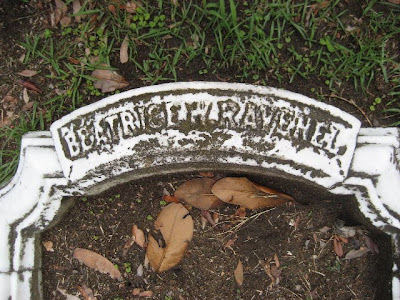
BEATRICE RAVENEL: The Confused Subjectivity of Modernism OR How I Came To Write Her Poem


If you don't already, after reading this post, you will think me daft.

The mind that used to be like the famous "steel trap" has become a notorious sieve, still stainless steel but with gaping, wide mesh.

Many years ago, someone steered me to the poetry of Beatrice Ravenel. It's one of those names, isn't it? A delight to say. Say it with me now: Beatrice. Ravenel. Beatrice Ravenel! In-to-na-tion as-cen-dante! I can practically feel the sharp taps on the head from my French linguistics professor (who was, sadly, obsessed with phonetics -- and corporal punishment with rulers).

Furthermore, like Seinfeld, I also enjoy the word salsa. From the episode about "The Pitch," where George and Jerry establish "nothing" as being the show's key concept:

GEORGE: So, what's happening with the TV show? You come up with anything?

JERRY: No, nothing.

GEORGE: Why don't they have salsa on the table?

JERRY: What do you need salsa for?

GEORGE: Salsa is now the number one condiment in America.

JERRY: You know why? Because people like to say "salsa." "Excuse me, do
you have salsa?" "We need more salsa." "Where is the salsa? No salsa?"

GEORGE: You know it must be impossible for a Spanish person to order
seltzer and not get salsa. (Angry) "I wanted seltzer, not salsa."

JERRY: "Don't you know the difference between seltzer and salsa?? You
have the seltzer after the salsa!"


Ravenel, salsa, seltzer, Beatrice. Also, multicolore and vraisembablement -- a regular party in the mouth, those!

Anyway. Yes, that's it. It must have happened that way -- that someone, with great intent, led me right to Beatrice Ravenel. How else would I have found her in this world overrun with Norton Anthologies and Citations of Authority? The last clear authority I acknowledge is 99 years out of date! The centenial celebration of the 1911 edition of the Encyclopedia Britannica is an exciting prospect. Er, to people like me, who excite over a word's mouth-feel and false etymologies.

Sal-sa. Multi-co-lore!

We are a small group, but likeable. Really. What is sad, and truly unfortunate, are those who think that these little performances emanate from reclusive virtuosos.

Do not!
Are not!

So, sieve steadily leaking, I searched the aforementioned beloved encyclopedia for any mention of Ravenel. What a moment of excitement when the search returned a hit from the article about Charleston, home of the poetess in question! At its tail, referential end, there is a brief allusion to a 1906 book on the city by one "Mrs. St. Julien Ravenel."

Forget your [dearth of] excitement and imagine mine! Then, as is usual, follow its rapid descent into disappointment. I turned to a Charleston County Public Library publication -- because librarians, constitutionally, cannot lie -- where I found this next to a picture of the "Ravenel House":

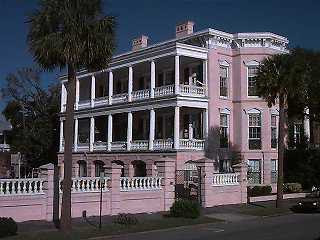
This house was also the home of his son, Dr. St. Julien Ravenel, the noted scientist who designed and built the Civil War semi-submersible torpedo boat, the Lucy, and was a leader in the development of the phosphate fertilizer after the Civil War. lt was also the home of Dr. Ravenel's wife Harriett Horry Rutledge, who, using the name Mrs. St. Julien Ravenel, authored the book Charleston: The Place and the People, and other works on local history.


Amazing that this decorated, decorous family name was lost to me for almost ten years.

Imagine, too, having to deal with a name like Whory Harriett in your playground days. C'mon, you know it had to happen! En plus, imagine being married to the progenitor of lazy-assed terrorists and their fertilizer bombs.

What? Oh, please, you are in charge of what-came-first insistances, and order, in general, and all those things.

Okay, so phosphate fertilizer isn't used in those home-grown, cheapo-cheapo production explosive devices. Mrs. St. Julien Ravenel was so greatly relieved when notified that she announced, "It is 5 o'clock somewhere," and poured herself a stiff drink.

Despite my amnesia for sourcework, those shiny metallic threads in the Ravenel tapestry, I retained an uncanny ability this last decade to recall a good many lines from Beatrice Ravenel's creations (with the slight caveat that I did not attribute them to her).

There was one piece in particular that I very much admired. A poem. I called it "Fear," and, as luck would have it, so did she.

You may not remember jotting down the phrase "on or about December 1910" from a lecture on Modernism in one of your lit classes but I assure you that you did. Let's go further and re-place the droplet in the ocean; Let's honor the context. This is what Virginia Woolf wrote in a 1923 essay titled Mr Bennett and Mrs Brown:

[I]t would be impossible to live for a year without disaster unless one practiced character-reading and had some skill in the art. Our marriages, our friendships depend on it; our business largely depends on it; every day questions arise which can only be solved by its help. And now I will hazard a second assertion, which is more disputable perhaps, to the effect that on or about December, 1910, human character changed.

I am not saying that one went out, as one might into a garden, and there saw that a rose had flowered, or that a hen had laid an egg. The change was not sudden and definite like that. But a change there was, nevertheless; and, since one must be arbitrary, let us date it about the year 1910.


August 24, 1870 - March 15, 1956: an interesting span, Ravenel's dates. The very time of planes and trains and automobiles. Oh, and Einstein.

The sixteen-year-old Beatrice experienced a major earthquake at 9:50 p.m. on August 31, 1886. Do you think that was formative? Transformative?

On January 23, 1890 -- the 24th being my birthday -- the Rev Father Duffee married Mr. W. H. Welcome, of St Louis, Missouri, and Miss Ginia Leyden, of Mobile, Alabama, in the Charleston of the young Miss Ravenel.

Did Beatrice take note of Virginia's response to Arnold Bennett, a portion of which is cited above, who had declared Jacob's Room a work of inaccessible characters -- who said something to the effect that she wrote stories incapable of surviving... (yes, I *could* look it up. bennett's assertions matter, obviously, and were provocative, but i am tired, this draft has been here over two weeks, and i fear that in the looking-up, my meaning will be altered. correct, but a stifling rectitude.)

You know that one string, the one that threads its way through everything? You know how it nags at you to touch it, grab it, pull it? It's the one that holds it all together, and tears it all asunder, disparate results of the same gesture.

About twenty-five minutes (and a week or so) ago, the internet produced another of its quiet, personal miracles by reuniting our author with her verse. Yes, I managed to find three of Ravenel's poems!

Thus it was that I was relieved of the bizarre and alarming belief that I was the author of one of them.

That's right.

I thought I wrote it.

I never crowed with pride, I never gave it recitation. I knew something was hinky about that memory!

Even back then, way back when... during my initial introduction to her work, she was all dressed up in Southern Camouflage, Refined. For some reason, I attached to the lilting syllables of be-a-trice-ra-ven-el images of moist gardens full of heavy air and heady perfumes, dripping insular ivy leaflets, climbing the careful red brick and piercing the mortar of staid, old Charleston homes. But we all know, if only thanks to Midnight in the Garden of Good and Evil, that there are some very strange, wonderfully different people in...

Savannah.

God, I entertain myself.

Do you see / Do you see how my poor mind / Works?

Anyway, the little contemporaneous criticism that you will find about this poet usually will rapidly tell you that Mrs. Ravenel lives in a former plantation home and that Mrs. Ravenel writes "occasional" poetry -- meaning not that she finds her muse every now and then, but that she composes to honor the events of life.

There is not, to my knowledge (we know well, already, how flawed is my knowing), a notable "occasional poetry" tradition in the United States. Here in Marlinspike Hall, deep, deep in the Tête de Hergé (très décédé, d'ailleurs)? We keep seven full time Occasional Poets on staff, with a dozen or so more on retainer.

Our Verse Section rounds out with three Pastoral Poets (who sleep in the barn and like our hens, are not producing much these days), a half-dozen Odists (usually to be found scattered among the various Listening Rooms, as Our Odes are still proudly declaimed to music), Uncountable Monotonous Modernists (question:reinvent;question:reinvent;question:reinvent), and the Polysemous Intertextuals (Postmodernists, really, but they refuse the reference; Every time Marlinspike Human Resources takes a census, there's a different number of PIs and lots of subterranean giggling) .

Anyway, our Occasional Poets are kept pretty busy, and enjoy unprecedented job security, at least in relation to the other scribes. Given that, they must, of course, demonstrate competency in a wide variety of subject matter -- imagine commissioning a poetic work for, say, some local triumph in animal husbandry, and finding out, at the last clonal minute that the Versemeister you're dealing with doesn't know Mendel from Oliver Wendell, and cannot fathom how the gelded horse still dreams!

Apparently, though, in the Charleston of Mrs. Ravenel's time, occasions begging memorialization were as thin and flitting as pastel tissue paper in air. To gird her loins in preparation for the occasions of her life that would birth such vague and foundless poetry, our Beatrice practiced Noteworthy Accomplishment -- specifically, Harvard and Scribner's. It's all in her nice bio over at the UNC Libraries, where her papers are entombed.

She will forever and always be of the card catalog, filed under the confident listing of Women Poets, American--South Carolina.

I figure she must have felt considerable anger at the environment which stifled her; I know it was poetry that relieved her impotence. There is just something moist, dark, and feminine about the Low-Country - engulfing.

Indeed, she wrote of a coast and in her anger at having been given, then having cultivated, a boundless voice yet no power? (Too bad that she wasn't properly impressed with herself -- She was, for years, self-supporting through published columns, short stories, and poems. There is a power in that, in not owing anyone for one's daily bread.)

Ravenel, it is said, sometimes came to sputters because she felt that South Carolinians were more interested in questions of race than in what was, to her, more pressing: women's suffrage. Tradition, The Old World, both supported her and inflamed her, this weird woman who ended in the camouflage of local Indians, in citations of totems.

Here is what she most wanted to say in terms of a Poetics: To be modern is to be disoriented in one's subjectivity. Trust me, she'd have said just that, eventually.

I know her, and understand her, because, remember, I wrote her poem.


FEAR

I am only afraid
Of the cold dull lids of eyes,
And the cold dull grain of sand in the soul,
Indurate, insensate, not to be made incandescent
Even by God.
I am afraid of the stupid people.

(Yemassee Lands, 77)


*** ** *** ** ***
From The Charleston Library Society Fall, 2009 Newsletter:

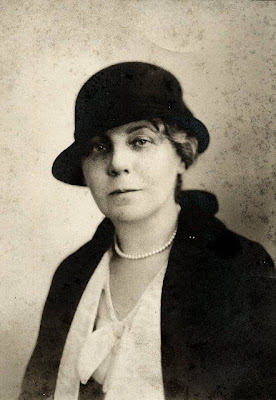
Beatrice Witte Ravenel
Beatrice Witte Ravenel was the third of six daughters
born to Charles Otto Witte, a German-born businessman
as well as German and Norwegian Consul to Charleston, a
philanthropist, a rose gardener, and a music lover. In 1866
Witte married Charlotte Sophia Reeves, twenty years his
junior and desperately poor after the “Confederate War.”
She was only 20 when her first daughter was born, and
over the next ten years a girl was born every two years.
Beatrice is characterized as “gifted with the brains of the
family” in youngest sister Laura’s memoir The Way It Was
in Charleston. Laura contends that Beatrice inherited
a “colossal” memory from her father and “cared more
for books and for reading,” though she was interested
in drawing, painting, and writing plays. She was also a
marvelous storyteller to “spellbound children.”
Beatrice’s sister Carlotta “had the style of the family,”
according to Laura, who writes that Carlotta “…had
a great talent for making doll’s clothes and was most
unselfish in giving her time for such things.” Thus perhaps
a handmade paper doll equipped with several beautifully
fashioned costumes in the Library Society’s Beatrice
Ravenel collection may be the work of Carlotta—perhaps
created for Beatrice St. Julian (Kitty) Ravenel, daughter
of Beatrice Witte and her first husband, Frances Gualdo
(Frank) Ravenel.
Beatrice proves herself to be an artist of sophisticated style
and elegant hand in her collection of drawings to illustrate
One Thousand and One Arabian Nights. Thirty-one elegant
art nouveau drawings, numbered and titled, are preserved
in the Beatrice Ravenel collection. The images are seductive
and mysterious, befitting the text that inspired them, and
remind the viewer of the highly stylized work of Aubrey
Beardsley.
When Beatrice married for the second time after the death of
Frank Ravenel, she did not have to change her monogram,
for she married Samuel Prioleau Ravenel, widower of
Florence Leftwich Ravenel, in December of 1926. The couple
left on a honeymoon to the Middle East and Europe, taking
Kitty with them and not returning for three years. Beatrice’s
journal of those travels, which is held by the Library Society,
contains a few small sketches of birds at Lake Maggiore in
Italy. Though Beatrice Ravenel later wrote interesting and
exotic poems which draw on the Voodoo culture in the
Caribbean, her collection in the Charleston Library Society
contains no illustrations from that era.


Collection Title: Beatrice Witte Ravenel Papers, 1892-1948
University of North Carolina Libraries
The Wilson Library
Southern Historical Collection (SHC)

Beatrice Witte Ravenel (24 August 1870-15 March 1956), daughter of Charles Otto and Charlotte Sophia Reeves Witte, was born in Charleston, S.C. Her father was a German-born businessman and civic leader in Charleston. Beatrice was educated at the Charleston Female Seminary, and, in 1889, enrolled in the women's division of Harvard University. While in college, she played a prominent role in a group of literary young men and women, including William Vaughn Moody, Trumball Stickney, and Norman and Hutchins Hapgood. She wrote for the Harvard Monthly and the Advocate, and published poems in Scribner's Magazine, the Chap-Book Magazine, and the Literary Digest.

In 1900, she married Francis Gualdo Ravenel, whose mother, Harriot Horry Ravenel, was a well-known writer and biographer. In 1904, Beatrice and Francis had a daughter, Beatrice St. Julien Ravenel. After the birth of her daughter, Beatrice Witte Ravenel lived on a plantation south of Charleston. This was the setting for several of her best poems, which primarily deal with the Yemassee Indian heritage of the Carolina low country. Francis Ravenel was no businessman, and, by the late 1910s, the sizable fortune left Beatrice by her father was gone. She helped support the family by writing fiction for Ainslee's, Harper's, and the Saturday Evening Post, and, after 1919, she wrote editorials for the Columbia (S.C.) State.

In the late 1910s, Beatrice began writing poetry again, and, in the early 1920s, came abrupt change in her verse. She ceased to write the sentimental abstractions of the waning genteel tradition and began producing free verse of notable economy of diction, precision of language, and vivid imagery. The formation of the South Carolina Poetry Society brought her into contact with other poets, including visitors such as Amy Lowell, with whom she formed a strong friendship.

In 1926, six years after Francis Ravenel's death, Beatrice married Samuel Prioleau Ravenel. After her second marriage, she no longer had to support herself and daughter through writing. The Ravenels traveled extensively. Though she wrote little poetry during her later years, one sequence based on the West Indies, unpublished in her lifetime, is among her most accomplished work. Beatrice Witte Ravenel died on 15 March 1956 at the age of 85. Her best known work is The Arrow of Lightening, a book of poetry published in 1926.
Saturday, March 6, 2010

see you later!

hi all --

i am hoping that tomorrow will find me energetic enough to post something worthy of your time and attention.

i apologize for swimming below the radar... but i like it down here.

it's cold.

and murky.

who doesn't love murky?

Tuesday, February 23, 2010

Eye Candy

Why in the world would someone do a search using the terms "crps rsd porn xxx"?

It cheered me immensely that a visitor from LLeida, Spain found me via this interesting and insightful method.

Creo que tiene buen gusto, mi nuevo amigo! Bienvenido a mi blog.

I am Number 1 in "crps rsd porn xxx"! Who knew that my ravaged limbs were actually eye candy?

Interesting that the post you'd think might catch the eye of Google's roving bot --XXX Porn Live, Totally Naked Women! XXX Porn! -- actually comes in second, behind a post whose obscenity the discerning little bot did well to perceive: The Hammer Dance: A Terrifying Update.

CRPS is certainly obscene. I don't even need to think twice on the matter. But am I willing to consider this degenerative neurological disease as participatory in the more acceptable category of pornography? Is it possible that there is any aspect to it that sexually excites?

I imagine the foot fetishist taking a gander at my right leg, at The Thing posited as its purported end.

I imagine said fetishist reaching out a quivering hand to stroke my beleaguered foot.

In my mind's eye? I see the poor deviant flying through the air (with the greatest of ease), having not sufficiently accounted for the violence of my allodynia.

The endings to "Blow in my ear and I..." provided by CRPSers are all likely to include spontaneous dismemberment and attempts to impale.

(Wouldn't My Allodynia make a lovely long lost title? The manuscript just recently discovered tucked inside the crinkly brown-paper backing of an understated masterpiece's understated frame? Writ longhand by a Brontë, it is the story of misfires and agonies, pain quietly endured by a quiet life -- on the quiet, requisite, heathered moors.)

So much of what I do out of deference to this disease has to do with The Sensual. I can only bear the touch of the softest cottons -- flannels, preferably, though my climate does not always allow them. I no longer can sleep under sheets, not even under the amazing linens I searched out in the early days of CRPS. These days, I am sandwiched between a soft, soft quilt and one that is so worn its batting is mostly entirely gone, that has been washed over 650 times, and that I drape carefully over just my midsection. Occasionally, when it is very cold, I will cover my arms. From just above the knee, down -- there can be nothing, no sheet, nothing. Lounge wear is just about my only-wear, though the one or two times a month that I go out, I do make efforts to look nice.

I focus on things that cannot hurt me: perfumes, perfumed lotions, jewelry (though the agony of rings and watches can be overwhelming).

For some perverse reason, I began to collect socks shortly after acquiring this disorder. Today, I am always barefoot but, periodically, I enjoy getting out my socks, remembering how I got my hopes up for this pair, pink and open-gauged, or for that pair, which promised to improve circulation. For a few years, I could wear a sock on my left foot but as things advanced, those socks joined their partners in the cardboard box tucked in the closet beside shoes unworn since 2002.

It has become the height of sexual fantasy for Fred to be able to hold my hand, and when he forgets and reaches for me, the pain in my heart eclipses the burning, stabbing predictability of my various neuropathies and dystrophies. Our kisses have become so chaste.

So, yeah. Okay -- it's fine by me if you should find something of desire here.

Talk dirty, why dontcha, and tell us about it.

Saturday, February 20, 2010

Alexander Haig: Photograph by Harry Benson.

from VF Daily: in memoriam

Alexander M. Haig Jr. died today at the age of 85. Harry Benson took this photograph of the former secretary of state and White House chief of staff for “Yes, Mr. President,” a portfolio from the April 2007 issue of Vanity Fair that reunited presidential aides from every administration since Harry S. Truman’s. Here is the caption that ran with it:


REPORTING FOR DUTY
Alexander Haig, former NATO Supreme Allied Commander, Europe, served Presidents Nixon (as a military adviser, deputy assistant for national-security affairs, and chief of staff), Ford (chief of staff), and Reagan (secretary of state), in West Palm Beach, Florida. “I’m in control here in the White House, pending the return of the vice president,” he famously insisted in the hectic aftermath of the assassination attempt against Reagan. Photograph by Harry Benson.

*Vanity Fair's "Yes, Mr. President" portfolio can be seen here.


BBC News is collecting listener/reader comments on Haig's death. (Updated as of 10:35 pm, 2/20/10) What impresses? Beyond his eternal I'm-in-charge moment and the associations with Nixon and Reagan? Is there anything that jumps out, or was he the general refused admission to the top-level meeting because he had no credentials? From these reminiscences, one gets the sense of Haig as being at his best within regimen, blending, in uniform, owing allegiance to those below as leader, as well as obéissance to those above; Outside that comfort, that organizational flow chart that is the military, he always seemed a bit lost.

A gentleman soldier?


YOUR COMMENTS:
I had the pleasure of a 45-minute on-stage interview with Mr Haig in 2001. He was, as would be expected, an extremely interesting and knowledgeable gentleman with enlightening thoughts on Reagan and subsequent Presidents. However having thought about his answers I am not sure he would have made a great President himself.
Colin Parker, Hemel Hempstead

This man had quite an exciting life and I'm sure he died knowing that his life was full of great opportunities. The unfortunate thing is that he will forever be remembered for his role in Nixon's defence and his remarks after Reagan's assassination, but behind that is one of America's greatest soldiers. Rest In Peace General Haig.
Conor Collins, Hampton, VA

I felt better with General Haig's statement during a rather scary time. We met General Haig in SE Asia during Vietnam War and my husband did some work for him in Europe. He was a total professional and gave a lot to his colleagues. He was an elegant fellow.
Claire Bannerman, Santa Rosa Beach, Florida, US

Mostly for the infamous "I'm in charge here" quote after Hinckley's assassination attempt against Reagan, but also grateful to him for his diplomatic efforts between the UK and Argentina during the Falklands conflict.
Muhammad Zaman, Oxford, UK

I remember an incident during my military career when, carrying out strict security arrangements and under specific orders from on high, I refused entry to a top level meeting by, as he was then, General Haig, the Supreme Allied Commander, as he had forgotten to bring his ID. His top level meeting was delayed by about 20 minutes while he sorted himself out. I knew who he was anyway. The look on his face and others, priceless!
Mike Diamond, Edinburgh

Former General Haig was my Battalion Commander (26th Infantry) in Vietnam and proved to be a fine leader and heroic soldier, in particular at the Battle of Ap Gu in 1967.
Joe Dirvin, Las Vegas, US

He was our company officer (11th) at the Naval Academy in 1955/56. He was a major and a great leader - we became the Color (#1) Company during his tenure.
Ira Hughey, Bellevue, NE, USA

Hague had a wry, self deprecatory sense of humour and, certainly to a British reporter covering the election in 1988, was fun to listen too, not something that could be said of Bush, who was always very careful what he said in public but had a reputation for malapropisms or the wooden Dukakis.
Stewart Fleming, UK


Small Town


--Myra's, Valdese, N.C. by davidbus159 on flickr


I love A Valdese Blog:

Part of a conversation overheard at the post office & duly reported to me so I could write it in this blog.

I like our post office. I sometimes approach entering buildings, such as restaurants and grocery stores, with a bit of trepidation, but I've gotten quite used to going into our little post office. I may not be the most sociable person who ever walked thru their door, but I can make the occasional small talk. Everybody has always been very friendly & helpful.

Anyway, I didn't witness this conversation, so I may not have it exact. It involved a passport application. If you get behind someone dealing with a passport application chances are you're going to be standing there a few minutes. But that's ok. Its a small town, where else would you go? [cont.]


I was lucky enough to live in a small North Carolina town when I was in high school. Unfortunately, my understanding of small town time, small town rules and regulations, and small town idiosyncrasies, and so did not appreciate my luck until many years later, years of being long gone.

I fell prey to calling such towns "charming." To be exactly honest, I classed them and their denizens (and mavens) with the snooty designation of Southern Gothic -- by which I meant steeped in quirky doom and quirkier gloom, with a dash of madwoman in the attic.

Worse? I came to believe (echos of Step Two in Alcoholics Anonymous: Came to believe that a Power greater than ourselves could restore us to sanity...) that the only good Southern [Gothic] writing came from wimmin.*

Now I know lots better about a few things. I know I like this blog that is sometimes about Valdese, North Carolina. After that? I hedge my bets.** One of my brother-units is a bookie, you know!

My favorite posts tend to be about humans and their willy-nilly dogs --"The Dogs of South Avenue" is a favorite (There is even a Part Two). But nothing -- no, nothing -- tops the very specific Pickles the Dog.

Pickles.
Pickles T. Dog. (T stands for the)
Pickles P. Dog (P stands for puppy)
P. Pickles Dog (if she's puttin' on airs)
P. Dog
P. Doggy
Gnarls Barkley
Doggers
Pickles Anne
Pickleheimer (Don't ask me why, Patti Anne just started doing it)
Monster Dog


Look, I deserve some relief from The Felines of Marlinspike Hall. One day, I'll tell The Story of My Dog Emma and there won't be a dry eye in the house.


*Tamarah Cohen: After days on the Internet and in the library, I have come to nothing more than the obvious: "'wimmin' is a semi-phonetic spelling of 'women', recently adopted by feminists...."(OED, 1989).

**HEDGE ONE'S BETS:
Fig. to reduce one's loss on a bet or on an investment by counterbalancing the loss in some way.


Bob bet Ann that the plane would be late. He usually hedges his bets. This time he called the airline and asked about the plane before he made the bet. John bought some stock and then bet Mary that the stock would go down in value in one year. He has hedged his bets perfectly. If the stock goes up, he sells it, pays off Mary, and still makes a profit. If it goes down, he reduces his loss by winning the bet he made with Mary.
(McGraw-Hill Dictionary of American Idioms and Phrasal Verbs.)

HEDGE YOUR BETS:
to try to avoid giving an opinion or choosing only one thing, so that whatever happens in the future you will not have problems or seem stupid
(Cambridge Idioms Dictionary, 2nd ed.)

A thousand words worth: Torture and Yoo

In the hoity-toity world of literary criticism, there is a term used to designate something sorta opposite to "cooptation." Not quite an antonym, it is difficult to pin its wiggly self to the stiff black stock paper upon which we display our dead insect pests.

Under glass.

To void a term.
To empty a term.
To suck a freaking term dry.

The thing is slimy, too, so we sometimes add vacuum suction to the volume of air (really mites, mosquito dander, one frizzy and split multicolored human hair, two hydrogen atoms, at least, and oxygen).

We hope to desiccate; We hope to be exceedingly tedious; Death to the term!

Sure, first we tried other things, less drastic, less noticeable -- but those wacky words! They remained in use.

Neonate. Nigger. Necromancer. Nazi. (And that's just *part* of the N-words. Must I follow my fellows and begin with A for Aborigines or go backward with a start at Zygote? Thanks, I didn't think so!)

Before bed last night, I did some wholesome reading over at this psychotic café of aborted thought. Of course, yes, it was a bad idea. Slap an X for Xenophobe on that sucker!

Actually, had it not been time to sleep -- wayyyyy past time to sleep -- I might have had a qualified appreciation for the site. My area of purported expertise is precisely in the relationship between image and word. So what if I am supposed to stay in the confines of eighteenth century French literature? Diderot got to walk right out of the frames and pages of his Salons... Why can't I?

I arrived at PsyWarrior's place via a search for a photograph. I was thinking about the impact that PBS made with its decision to air photos of United States casualties in the Iraq and Afghanistan wars. By the way, to make a study of it, this is a well thought out place to begin -- Media Literacy: Images of War. As even the term death is voided by some kind of human immunological protective response, the war of words continues, but illustrated. We are marvelously still concerned about what is polite, what is couth, and how-shall-we-hold-our-teacups, must-i-really-curtsy-to-the-queen?

Bill Moyers even got to wondering whether respect is something that we really ought to owe, and, of course, if so -- to whom is the debt, and what is the currency?

I discovered that I do not have it in me to research the nag, nag, nag in my head. As I began to explain above -- I landed at PsyWarrior in the course of searching for visual impact. I wanted a picture of Iraqi war dead, civilian and military -- something along the lines of the poster-like spread that many newspapers published of victims after the 9/11 terrorist attacks -- those nine long years ago.

Google search led me to a poster published on Herbert A. Friedman's blog on the history, means, and uses of psychological warfare. He claims that it was created by an antiwar group -- but that it was coopted by Iraqi propagandists who used it in ad campaigns against the United States.

[Aside: Man-O-Man, another term in the process of being vacated, voided? "American." I try to be aware of my wrong usages, and the Jeux-O do help to drive the point -- but jeez, what are we supposed to call citizens of the United States? What? "Citizens of the United States"? Cute, very cute. Too many characters. That would mean death to my 140-limit tweets. And uscit sounds too much like ocelot, God forbid I be the Author of Confusion.]

Okay, so he's just another asshole, retired. However, knowing something of military men, I presume him honorable, in some technical chapter-and-verse Rules of Engagement kind of way.

But I cannot find another source for the poster he published! It's driving moi batty. If you find it, would you please let me know? He requires that *his* permission be granted to reproduce the thing... and I am just not dressed for going out. I need to wash my hands first.

As usual, it matters -- how one gets from Point A to Point B. We'd like to stake a claim for linearity, and for that line to go from vague and uninformed to perfect intelligibility, for logic as wielded by philosophers.

But words, and pictures, are tricksters.


1885 illustration from Mark Twain's The Adventures of Huckleberry Finn, captioned "Misto' Bradish's nigger"


After a steaming mug of coffee and a piece of whole wheat toast, I settled down to work a bit this morning, satisfied and sated, both.

The sun was shining, the sky was blue. I had a lot to do. If you're already humming "I read the news today, oh boy..." -- well, you must be one of My Beloved (but your demographics are safe with me!)

Report Faults 2 Authors of Bush Terror Memos
By ERIC LICHTBLAU and SCOTT SHANE
Published: February 19, 2010

WASHINGTON — After five years of often bitter internal debate, the Justice Department concluded in a report released Friday that the lawyers who gave legal justification to the Bush administration’s brutal interrogation tactics for terrorism suspects used flawed legal reasoning but were not guilty of professional misconduct.

The report, rejecting harsher sanctions recommended by Justice Department ethics lawyers, brings to a close a pivotal chapter in the debate over the legal limits of the Bush administration’s fight against terrorism and whether its treatment of Qaeda prisoners amounted to torture.

The ethics lawyers, in the Office of Professional Responsibility, concluded that two department lawyers involved in analyzing and justifying waterboarding and other interrogation tactics — Jay S. Bybee, now a federal judge, and John C. Yoo, now a professor at the University of California, Berkeley — had demonstrated “professional misconduct.” It said the lawyers had ignored legal precedents and provided slipshod legal advice to the White House in possible violation of international and federal laws on torture. That report was among the documents made public Friday.

But David Margolis, a career lawyer at the Justice Department, rejected that conclusion in a report of his own released Friday. He said the ethics lawyers, in condemning the lawyers’ actions, had given short shrift to the national climate of urgency in which Mr. Bybee and Mr. Yoo acted after the attacks of Sept. 11, 2001. “Among the difficulties in assessing these memos now over seven years after their issuance is that the context is lost,” Mr. Margolis said.

Indeed, the documents released Friday provide new details about the atmosphere in which Mr. Yoo and the Justice Department prepared their initial findings in August 2002, shortly after the capture of Abu Zubaydah, suspected of being an operative for Al Qaeda.

The report quotes Patrick Philbin, a senior Justice Department lawyer involved in the review, as saying that because of the urgency of the situation, he had advised Mr. Bybee to sign the memorandum, despite what he saw as Mr. Yoo’s aggressive and problematic interpretation of the president’s broad commander-in-chief powers in trumping international and domestic law.

Mr. Philbin said that “given the situation and the time pressures, and they are telling us this has to be signed tonight — this was like 9 o’clock, 10 o’clock at night on the day it was signed — my conclusion” was that it was permissible for Mr. Bybee to sign the memorandum. “They” apparently referred to White House officials....


It has taken a couple of years, but I no longer react to Mr. Yoo's name by leaping, cursing, or baking bread. True, I do pause to wonder about the direction in which my alma mater has gone. And, yeah, okay, I do quickly search out succor here, and sweeten my memory with this, and cheer on the SF Bay Area Chapter of the National Lawyers Guild.

But the fact, as they say, remains.

Yoo is still a professor in good standing. But now, by golly, I've planted so many asterisks after his name that he barely registers anymore on The Outrage Meter.

I've never made poppy seed bagels before, wish me luck!

{she pirouettes figures eight, nine, and ten -- into the kitchen -- toes taut, responsive, screaming damn:damn:damn}

Yoo, who?

Friday, February 19, 2010

Complex regional pain syndromes: new pathophysiological concepts and therapies

Complex regional pain syndromes: new pathophysiological concepts and therapies
European Journal of Neurology
C. Maihöfner, F. Seifert and K. Markovic
Department of Neurology, University Hospital Erlangen, Schwabachanlage ; and Department of Physiology and Experimental Pathophysiology, University of Erlangen – Nuremberg, Universitätsstraße, Erlangen, Germany

Correspondence to Christian Maihöfner, MD, PhD, Department of Neurology/Institute of Physiology and Experimental Pathophysiology, University of Erlangen – Nuremberg, Schwabachanlage 6, D-91054 Erlangen, Germany (tel.: +49 9131 853 3001; fax: +49 9131 852 2497; e-mail: christian.maihoefner@uk-erlangen.de).

Received 7 April 2009 Accepted 22 December 2009
Published Online 18 February 2010


Complex regional pain syndrome (CRPS), formerly known as Sudeck's dystrophy and causalgia, is a disabling and distressing pain syndrome. We here provide a review based on the current literature concerning the epidemiology, etiology, pathophysiology, diagnosis, and therapy of CRPS. CRPS may develop following fractures, limb trauma or lesions of the peripheral or CNS. The clinical picture comprises a characteristic clinical triad of symptoms including autonomic (disturbances of skin temperature, color, presence of sweating abnormalities), sensory (pain and hyperalgesia), and motor (paresis, tremor, dystonia) disturbances. Diagnosis is mainly based on clinical signs. Several pathophysiological concepts have been proposed to explain the complex symptoms of CRPS: (i) facilitated neurogenic inflammation; (ii) pathological sympatho-afferent coupling; and (iii) neuroplastic changes within the CNS. Furthermore, there is accumulating evidence that genetic factors may predispose for CRPS. Therapy is based on a multidisciplinary approach. Non-pharmacological approaches include physiotherapy and occupational therapy. Pharmacotherapy is based on individual symptoms and includes steroids, free radical scavengers, treatment of neuropathic pain, and finally agents interfering with bone metabolism (calcitonin, biphosphonates). Invasive therapeutic concepts include implantation of spinal cord stimulators. This review covers new aspects of pathophysiology and therapy of CRPS.

Gall and Other Humors


There are certain touchstone issues, certain basics, to which one cannot fail to bring full passion. To not do so is to betray oneself.
Ooooh, I get all in a lather when reflexive pronouns are bandied about, willy-nilly. They are so... personal.

I hope to surround myself, even when just reading, just cooking, merely blogging, with dedicated people.

Especially those with whom I agree.

(Occasionally, I welcome spirited debate but let's face it, this is my blog, where I come for comfort and to avoid the everlovin' Ah! je ris de me voir si belle en ce miroir, La Bonne et Belle Bianca's witless tune from Gounod's Faust. You won't believe this: Charlotte Church has recorded The Jewel Song! The Castafiore is grief-stricken, and off her feed, too. She has even lowered the volume a bit when not performing.)


The Castafiore won't admit it but it absolutely galls her. A fourteen year old fillette, what was she, raised in zeee barn, this bairn? Tellement sectuallleee précoce, it is the embodiment of my **embarras!

For the first time *ever* since I have known Bianca, she is singing a new tune:

Une jeune fillette
De noble coeur
Plaisante et joliette
De grand’ valeur,
Outre son greon
l’a vendu’ nonette,
Cela point ne luy haicte
Dont vit en grand’ douleur.


This new song seems to please her.

Lately, then, Our Irrepressible Diva seems to school me daily in bile, and in bitterness of spirit. But we all manage to live lovingly and peaceably, because her poor sores are so raw, her acrid sniping so transparent of her childlike disappointment. Without this sort of base and basic honesty, she would not be so great or so sought out.

[I'm not supposed to tell, but she is going to be offered a movie role! Fred, The Felines and I have barely been able to suppress our excitement. Her agent is finalizing the terms, and the big announcement will come down next Thursday. I'm baking a cake. You can even follow the progress of this blockbuster on Twitter!]

You probably have figured out by now that, in this blog, you will rarely be spared the intricacies of inspiration's flow. As improbable as it sounds, the primordial goo (and, yes, woo, too) that brought us to this point is the mix of Castafiore's shameful resentments, the eternal story of Faust (all those devilish deals), etymology, coincidence, and favorite bloggers.

Also -- the steady drip:drip:drip of water torture happening somewhere, right now, because of the explicit endorsement by nasty, leering, little men like Dick Cheney.

Buckeye is a less cynical student of politics than I am. And he works to keep his spirit generous, the most important of spiritual attributes. I think he has been generous to Dick Cheney, even as he accretes a daunting Cheney Series. That kind of accretion is a slow and steady progress of layer-upon-layer, careful, natural, thin alluvion that, over time, adds acreage from piles of moss, peat, dirt, runoff, and molecules of manure.

Cheney doesn't shock me anymore -- although it is increasingly clear that Cheney would love to attach me to some highly charged wires, if he had the chance and only enough water to tweak the juice being applied to my pierced and bloody nipples.

But I have a modicum of hope for my soul, because Cheney does still enrage me.

Not to sound the tragic hero, but the world and its politicians have so disappointed that I feel, regretably, unshockable. What remains for me is snide disapproval, and given a prurient interest in abnormal psychology, a wish to get at the roots of Cheney's unabashed *gall*.

We must give it the good pronunciation, I think, to mark each Cheney moment: not the International Phonetic Alphabet Pronunciation [ŭn'ə-bāsht'] but a more shakespearian meter -- [ŭn'ə-bāsh'-ɛd]. What is the value in striving to maintain a common international standard, something to which one might appeal for guidance, with guileless faith in the centuries of work and evaluation, all the dedicated generations of testing, trying, judging?

What?
Oh.
Oops.

I was talking about the IPA. What were you thinking about?

Charles Hodgson hosts a daily podcast called "Word of the Day." On 29 December 2006, the word was gall.

That was the day Saddam was executed "with fear in his face"; That was the day that Mike Dunford of the Zoology Department at the University of Hawaii, Manoa, and a regular contributor to The Pandas Thumb published his *quote* of the day , from Terry Pratchett's Hogfather:

"Thank you. Now . . . tell me . . ."

WHAT WOULD HAVE HAPPENED IF YOU HADN"T SAVED HIM?

"Yes! The sun would have risen just the same, yes?"

NO.

"Oh, come on. You can't expect me to believe that. It's an astronomical fact."

THE SUN WOULD NOT HAVE RISEN.

She turned on him.

"It's been a long night, Grandfather! I'm tired and I need a bath! I don't need silliness!"

THE SUN WOULD NOT HAVE RISEN.

Really? Then what would have happened, pray?"

A MERE BALL OF FLAMING GAS WOULD HAVE ILLUMINATED THE WORLD.

They walked in silence for a moment.

"Ah," said Susan dully. "Trickery with words. I would have thought you'd have been more literal-minded than that."

I AM NOTHING IF NOT LITERAL-MINDED. TRICKERY WITH WORDS IS WHERE HUMANS LIVE.

"All right," said Susan. "I'm not stupid. You're saying humans need . . . fantasies to make life bearable."

REALLY? AS IF IT WAS SOME KIND OF PINK PILL? NO. HUMANS NEED FANTASY TO BE HUMAN. TO BE THE PLACE WHERE THE FALLING ANGEL MEETS THE RISING APE.

"Tooth fairies? Hogfathers? Little -"

YES. AS PRACTICE. YOU HAVE TO START OUT LEARNING TO BELIEVE THE LITTLE LIES.

"So that we can believe the big ones?"

YES. JUSTICE. MERCY. DUTY. THAT SORT OF THING.

"They're not the same at all!"

YOU THINK SO? THEN TAKE THE UNIVERSE AND GRIND IT DOWN TO THE FINEST POWDER AND SIEVE IT THROUGH THE FINEST SIEVE AND THEN SHOW ME ONE ATOM OF JUSTICE, ONE MOLECULE OF MERCY. AND YET - Death waved a hand. AND YET YOU ACT AS IF THERE IS SOME IDEAL ORDER IN THE WORLD, AS IF THERE IS SOME . . . SOME

RIGHTNESS
IN THE UNIVERSE BY WHICH IT MAY BE JUDGED.

"Yes, but people have got to believe that, or what's the point-"

MY POINT EXACTLY.

She tried to assemble her thoughts.

THERE IS A PLACE WHERE TWO GALAXIES HAVE BEEN COLLIDING FOR A MILLION YEARS, said Death, apropos of nothing. DON'T TRY TO TELL ME THAT'S RIGHT.

Yes, but people don't think about that," said Susan. "Somewhere there was a bed. . ."

CORRECT. STARS EXPLODE, WORLDS COLLIDE, THERE'S HARDLY ANYWHERE HUMANS CAN LIVE WITHOUT BEING FROZEN OR FRIED, AND YET YOU BELIEVE THAT A . . . A BED IS A NORMAL THING. IT IS THE MOST AMAZING TALENT.

"Talent?"

OH, YES. A VERY SPECIAL KIND OF STUPIDITY. YOU THINK THE WHOLE UNIVERSE IN INSIDE YOUR HEADS.

"You make us sound mad," said Susan. A nice warm bed...

NO. YOU NEED TO BELIEVE IN THINGS THAT AREN'T TRUE. HOW ELSE CAN THEY BECOME? said Death.


Creepy, no? Alignment of planets? God having His Fun? Serendipity? Some kind of Astral Nudge?

Anyway, enough of this silly present time! Backward we shall go, as a Nation and as a dilettante at etymologies.

The podictionary word for today is gall: It takes a lot of gall to submit an invoice to your lawyer for the time you sat in his waiting room. The meaning of this sense of the word gall is boldness or effrontery. The sense comes from the bitterness involved in such bold moves since the gall bladder contains a bitter yellow fluid.

The fluid is named gall because it is yellow and the root of its name goes back to Indo-European and was also the source of the name for that yellow metal we all covet so much, gold. But funnily enough there are two other types of gall. If something galls you, it means it gives you pain. In this case the word gall evolves from an Old English word for the places on a horse where a saddle or harness has rubbed the skin raw. A swollen knob on a tree is also called a gall and this is from Old French.

There is some suspicion that the swollen knob gall and the open sore gall might have the same roots, but maybe not. Gall the bitter yellow fluid is also known as bile and it is important in our digestive system. It would have been important to treat the galls on your horses if you expected to get much work out of them. But what kind of importance could the galls of trees have? In fact, for the purposes of English etymology tree galls had a fair amount of importance, particularly the galls of oak trees. What would happen you see is that a little wasp would come along and drill a hole into the bark of an oak tree and plant her eggs in there for safekeeping.

The tree did not like this, not one little bit. And so the tree grew a knob around the wasp eggs to protect itself. But when the monks and scholars of 1000 years ago saw one of these oak galls, they knew that inside was a little store of acid produced by the tree. They happily crushed the oak gall and used water or vinegar to draw out the acid, then added gums to make the mixture a little less runny, and then added their favorite mixture of rust and soot and other things to give the liquid whatever color they wanted. The result was something they called encaustum in Latin, we’d call it ink, but the word ink didn’t come into use until Middle English.

It was the acid from the oak gall that gave the ink the power to etch its way into the surface of the velum on which they wanted to write. The velum was made from animal skins, mostly sheep and it’s because these ancient scribes took the time to use such high quality methods and materials that we can still read today what they wrote way back then. If they had used paper it would have crumbled to dust or blacked with oxidization long before now. Encasutum is related to caustic and both words go back to a Greek for burn. So even though these different types of gall seem to come from different etymological sources, they all have a sting to them.

Don't you just love words?

It helps me to have etymologies in mind, and in this case, I am searching out something of the effect an old Army nurse -- reminiscent of a bitter prune -- once explained to me, back in those halcion Candy Striper days: She said that she, like many other good nurses surrounded by whiny young men newly separated from their Mothers, tended to give their young buttocks an unexpected and sharp slap just before plunging in the needle through which a good dose of penicillen was administer to cure their... whatever. There was a rationale to this intentional infliction of pain. The first pain took their attention away from the second one. Occasionally, a thick grab of booty flesh was converted into a mean twisty pinch. Those, I twice saw draw blood and the 18 year olds cried big wet tears.

After a few weeks on the wards, I saw that what had been perceived as sadistic and cruel (I mean, these were essentially healthy and wonderfully formed derrières. Innocent cheeks, as it were.) The greater purpose had escaped me. I've never been swift on the uptake.

I have fought hard, here where you cannot see or know me, to put some distance between Dick Cheney and his ugly words on Valentine's Day and the strict definitions and trusty origins of the WordWeapons I toss about.

Because, as Obama (and, okay, maybe someone else before him) said, "Words matter." Certainly, we have witnessed the staying power of the S-Word, or rather its depletion by the fanatical right.

But when shit remains shit instead of transforming into rich dark loam? Sometimes all you've got left to escape it are fancy tricks of dictionaries and serendipitous allusions.

Unless you are Buckeye Surgeon, and then you manage to voice your outrage, all the while still trying to understand. That is wayyyyy more than I am willing to do for DickWad Cheney.

Buckeye likes to ease into things with a mild video presentation:


I'm sorry, but I'm still sort of reeling from the fact that Cheney actually went on national television and admitted he was a "big supporter of waterboarding". And he didn't even use one of the Orwellian euphemisms (enhanced interrogation techniques); he actually said the word waterboarding. Now waterboarding is illegal according to US law, international law, the ICRC, the Geneva Conventions, the UN Convention Against Torture, Amnesty International, Human Rights Watch, etc etc. And he had the smug audacity to go on the air and brandish his unabashed support for an illegal, inhuman practice that ought not to be condoned under any circumstances. Why would he do that?

Because Dick Cheney is a ruthless, arrogant son of a bitch who thinks he can do whatever he wants. It kills him to have to silently bear the world's moral condemnation. He wants to say he tortured. He wants the world to know how "tough" he was. He wants the "liberals" and the "soft underbelly of the American left" to know how he sat on that wall and defended America and made the hard choices that the likes of Obama in their "faggoty white uniforms" would never or could never do themselves. Baring his teeth, shaking his fist like he did on Sunday--- it's like he was just daring someone to challenge his right to call a Code Red. He truly sees himself as some sort of martyred patriot.

But you're nothing more than a common criminal, Dick. None of us are impressed with your bluster. Your time will come.


**embarras: a river in E Illinois, flowing S and SE to the Wabash River. 185 mi.
(298 km) long.

Also, Embarrass.